Narrative Equity
A framework for measuring the accumulated belief that surrounds a sporting institution.
ABOUT
Renowned philosopher Pep Guardiola, on playing Real Madrid in the 2022 Champions League semi-final at The Bernabéu, said: “If we have to compete with their history, we don’t have any chance. Their history speaks for itself.” City would go on to lose that semi-final tie, and in the aftermath, pundits spoke about their inability to get past not just the team on the pitch, but the ghosts in the stands of the Bernabéu.
Narrative Equity is an effort to name and track the accumulated belief surrounding an institution. Institutional belief is shaped by history, identity, performance, and perception. It carries inertia, and can feel like it’s moving at a glacial pace until all of a sudden, everything begins to turn.
The framework expresses an institution’s position on the Belief Curve, a scale from -100 to +100. Zero is the threshold that matters: above it, belief is compounding in an institution’s favor; people are bought in and generally see the world from a glass half full perspective. Below it, belief is working against everything the institution does; glass half empty. Crossing zero tells a story. A club moving from -8 to +3 means something; moving from 42 to 51, something, but less so.
The Narrative Equity framework has launched in sport because sport is where belief is most visible and feedback is fastest. Outcomes arrive weekly or even more often, narratives play out in public, and the stakes, especially for fans but really for all parties, are existential. But the application does not need be limited to sport: any institution people believe in, or have stopped believing in, carries narrative equity and can be analyzed through a similar lens.
METHODOLOGY
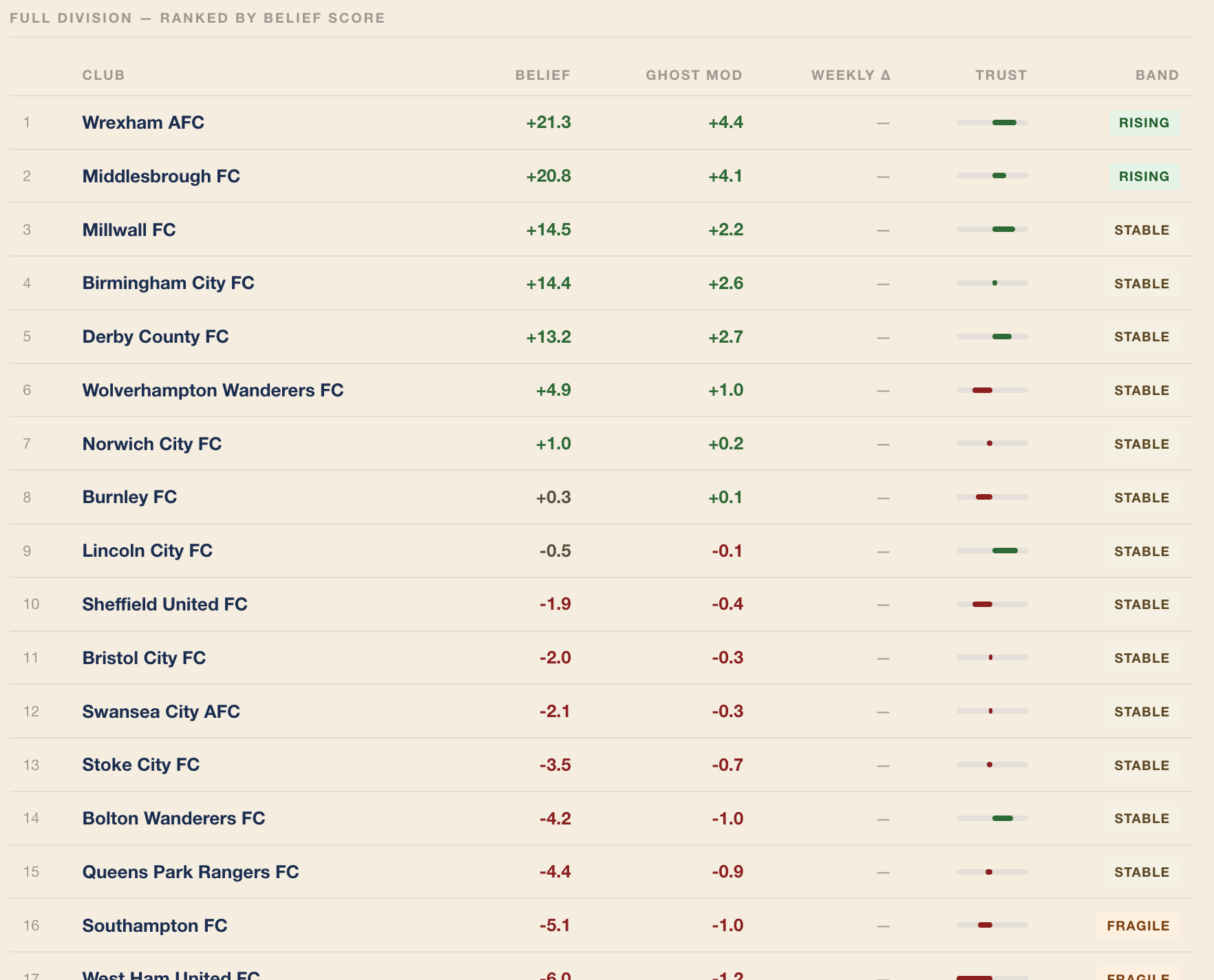
The full framework is published in the lab’s foundational paper. This includes its components, weights, modifiers, and the design decisions behind them. The paper documents how the Belief Curve is constructed, including the three live components of the weekly score, the ghost modifiers that carry an institution’s history into its present, and the events layer for the activities of today.
INSTRUMENTS
The framework runs live. Its instruments publish on a fixed cadence, in public, with their methods on the record.
The Belief Index is a weekly measure of fan belief across all 24 clubs of the EFL Championship, published every Monday of the season.
The Giant Killer Index is an event-driven instrument published when cup draws are made. A combination of factors measure which underdogs carry genuine upset potential in a cup competition.
INDEPENDENCE
Grampians Lab publishes judgments about institutions that may also, now or later, be clients. Four commitments are designed to maintain independence and govern all published scores.
01 Publication Discipline
The Belief Index publishes every Monday of the season, without fail, no matter what the numbers say.
02 Prediction Record
Season-shape predictions are written, timestamped, and published before outcomes are known. If the framework claims to read the texture of a season, the record has to exist before the season does. You can view the record here.
03 Published Revision Log
Institutional trust scores move only on identifiable events. Every revision is dated, justified, and published. View the log here.
04 Client-scoring policy
Scored institutions can engage the Lab commercially. Scores are never negotiable, preview-able, or delayed as part of any engagement. Every commercial relationship is disclosed on our policy page. Read the policy here.
WORKING WITH US
Grampians Lab is open to working with clubs, leagues, broadcasters, brands and investors. The entry point is usually a conversation around divergence: the gap between what an institution has inherited and where it stands today, understanding what that gap is doing, and exploring how to change it.
Engagements with clients do not impact methodology or outcomes.